
Fuel consumption figures
How Solmex works out litres per hour and litres per 100 km, why each machine is compared with its own history, and when a fill-up is flagged.
Every consumption figure in Solmex is fuel divided by how far the meter moved. This article explains what that means in practice, so you can tell a real problem from a gap in the records.
Before you start
- You need Fuel: View to see consumption figures.
- Consumption can only be measured when fill-ups carry a meter reading. See Log a fill-up on a machine.
Per hour or per 100 km
Each machine is measured by one meter:
- Hourmeter if it has one. Consumption is shown in litres per hour (L/h or L/hr).
- Odometer otherwise. Consumption is shown in litres per 100 km (L / 100km), the way drivers and spec sheets quote it.
Hours and kilometres are never added together. On Fuel Management, machines measured in hours and machines measured in kilometres are reported side by side, each with its own coverage, never as one combined figure.
How a rate is worked out
A tank is filled at the end of the work it did. So the fuel put in at one fill-up paid for the work since the previous fill-up. Solmex takes two consecutive fill-ups that both carried a meter reading, and divides the litres of the second by the meter movement between them. That pair is called a span.
A span only counts when nothing interrupts it:
- if a voided fill-up sits between the two, the span is not used
- if a fill-up with no meter reading sits between them, the span is not used
- if the meter did not move, there is nothing to divide by
Readings entered on Daily Meter Entry alone are not enough. The reading and the fuel must come from the same fill-up, which is why the meter reading at the pump matters.
The machine's own baseline
Solmex judges a fill-up against the machine's own usual rate: the median of its most recent spans. It needs at least three spans before it trusts a baseline. Until then, the machine's Fuel tab shows Avg Consumption as "Not enough history yet".
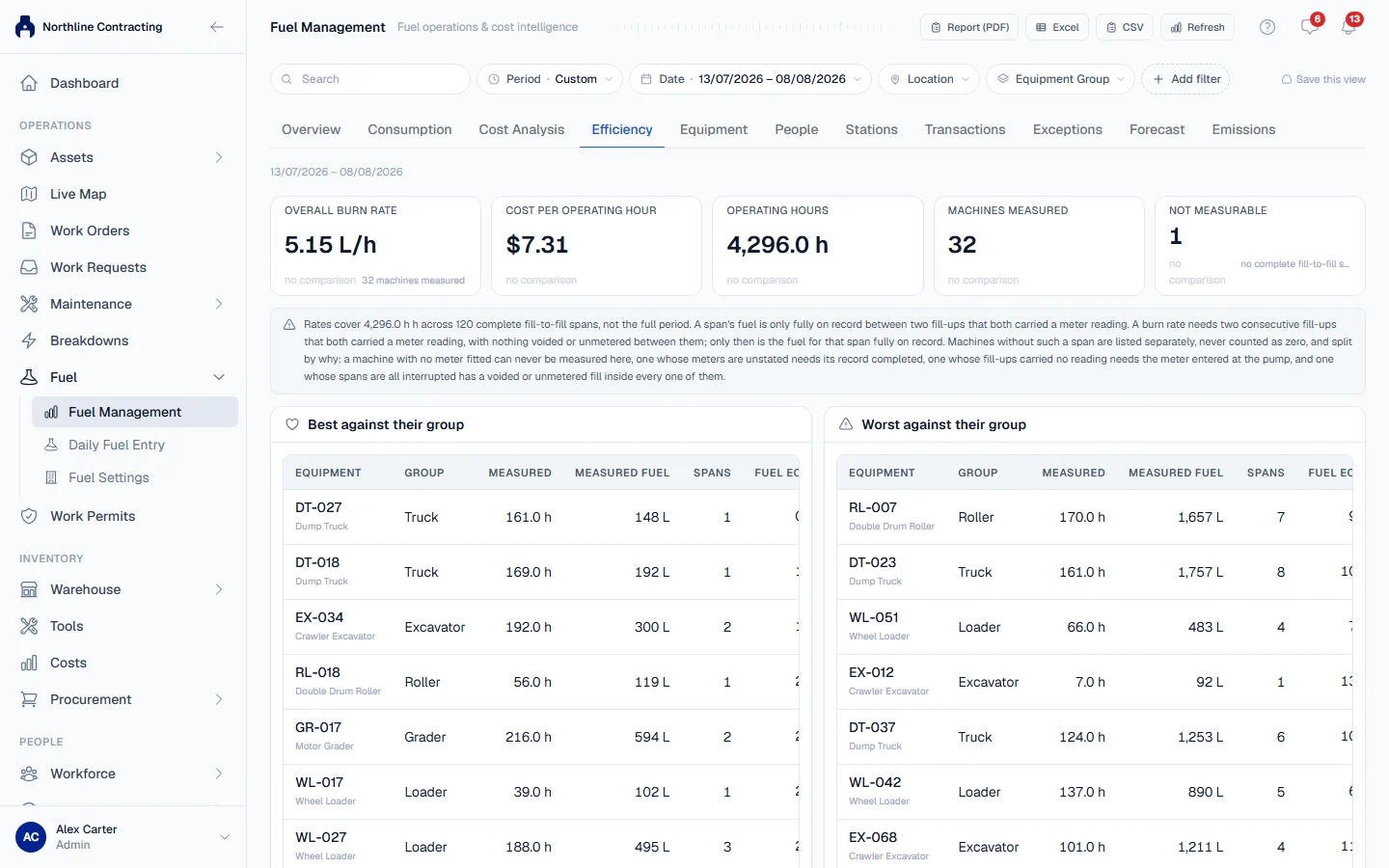
There is no manufacturer figure and no comparison with other machines in this check. On the Efficiency tab, machines are ranked against the median of their own equipment group, which is real and checkable.
When a fill-up is flagged
When you save a fill-up, its implied rate is compared with the baseline:
| How far from the baseline | What happens |
|---|---|
| Within 20% either way | Nothing. This is normal. |
| 20% to 50% off | A Warning that you confirm before saving. |
| More than 50% off | A Critical warning, with the words "Could be a typo, a leak, or theft". You still decide whether to save. |
The message gives this fill-up's rate and the machine's usual rate, in its own unit.
On Fuel Management, the two directions are reported differently. Far above the baseline is listed as consumption above the machine's own baseline: a fault, a leak or a hard job. Far below is listed as Fuel records may be incomplete for this interval, because fuel does not un-burn; the usual cause is a fill-up that was never logged. A genuine partial top-up looks the same, so it is a question, not a conclusion.
Machines that cannot be measured
Some machines burn fuel but have no consumption figure. On the Efficiency tab they are listed under Fuelled but not measurable, with a reason:
| Reason | What to do |
|---|---|
| No meter fitted | Nothing. The machine is recorded as having no meter. |
| Meters not stated | State the machine's meters on its record. |
| No fill-up carried a meter reading | Record the meter at the pump from now on. |
| Every span has a voided or unmetered fill in it | Record readings on every fill-up. |
| Meter did not move | Check the meter is being read. |
The tank capacity check
When a machine has a Fuel Tank Capacity on its record, Solmex can check two things no history is needed for: a fill cannot be larger than the tank, and a machine cannot burn more between two fills than its tank holds. When a span implies more than that, a fill-up was probably not recorded. See Fuel Settings for the first check, and add tank capacities to your machines to switch both on.
Troubleshooting
| What you see | What to do |
|---|---|
| "Not enough history yet: needs 3+ fill-ups with a meter reading" | Keep recording the meter at every fill-up. |
| "Cannot be measured: this machine carries no meter" | Expected. Its fuel is recorded but has nothing to divide by. |
| "Cannot be measured: nobody has stated which meters this machine carries." | State the machine's meters on its record. |